
The Epstein Files: Where Things Stand Now
What the black ink tells us about power, protection, and a broken promise of transparency.

When Congress passed the Epstein Files Transparency Act—by an overwhelming bipartisan margin — and when the president, who had spent months trying to derail it, reluctantly signed it into law, the public was promised something radical by modern Washington standards: transparency.
What we received instead, on December 19, was a masterclass in bureaucratic contempt.
Roughly 40,000 pages were released. That sounds impressive until you see them. Hundreds of pages are rendered entirely illegible. Thousands more are so aggressively redacted that they communicate nothing beyond the government’s determination not to communicate. Entire documents appear as solid black rectangles. Others are blank. One file even blacks out part of the ZIP code of the U.S. Attorney’s Office in New York City — a public address, for a public building, run by a public agency. This is not redaction in service of justice. It is redaction as farce.
The Department of Justice insists this is all perfectly reasonable. There are, we are told, more than a million additional pages still under review. Redactions are necessary to protect victims. Time is required. Patience is advised.
But the law anticipated this argument — and rejected it. Explicitly.
The statute forbids withholding or redacting records on the grounds of embarrassment, reputational harm, or political sensitivity. It was written precisely to prevent what is now happening: the transformation of a transparency mandate into an exercise in concealment. If the law were a physical object, the administration has treated it less like a binding statute and more like a polite suggestion printed on tissue paper.
What makes the situation worse — far worse — is that the Justice Department has taken the extraordinary step of warning the public not to trust the very documents it has released. Some of the materials, DOJ officials note, include unverified claims, forged letters, fake videos, and FBI tip forms containing fantastical allegations. That is technically true. It is also beside the point.
The law requires the release of files related to the Epstein investigation, not the curation of a narrative. Dumping disorganized, context-free material into the public domain, while burying anything substantive under black ink, has predictable consequences. Confusion flourishes. Conspiracies metastasize. And the government, having created the chaos, shrugs and says: Don’t blame us if people draw the wrong conclusions.
This outcome was not an accident. It was inevitable.
During the 2024 campaign, Donald Trump repeatedly promised to release the Epstein files. The promise fit neatly into a broader mythology: a corrupt elite, hiding monstrous crimes, finally exposed by a fearless outsider. Many Americans believed it. At the start of 2026, a growing number believe something else: that Trump is now one of the powerful few using the machinery of government to keep the public in the dark.
The White House denies this, of course. But denial becomes harder to sustain when evidence briefly appears and then vanishes.
When photographs showing Trump among Epstein’s effects were quietly removed from a DOJ website only to reappear hours later after public outcry, Deputy Attorney General Todd Blanche offered an explanation: The Southern District of New York, he said, had flagged the images for further review to protect victims.
Victims, in this formulation, apparently require protection from a photograph containing the image of the current president of the United States. One struggles to understand what species of victim advocacy demands the temporary disappearance of evidence that might prove politically inconvenient.
Blanche’s assurances might carry more weight were he not Donald Trump’s former personal defense attorney. That fact alone does not prove misconduct. It does, however, raise a question the administration has not answered: Why should the public trust the judgment of a Justice Department leadership team so intimately tied to the man most politically exposed by these files?
Redaction is not proof of innocence. It is, however, an insult to intelligence.
Members of Congress are not pretending this is normal.
Representative Thomas Massie, the Republican co-sponsor of the legislation, has accused the administration of violating both the spirit and the letter of the law. Representative Ro Khanna, his Democratic counterpart, has gone further, publicly raising the possibility of impeachment or criminal referrals if compliance is not achieved. When lawmakers from opposite ends of the ideological spectrum converge on the same conclusion, that the executive branch is flouting a legal mandate, it is usually because something has gone badly wrong.
The survivors understand this better than anyone.
Marina Lecerda, who testified that Epstein abused her when she was 14, described the release as another betrayal. “All of us are infuriated by this,” she said. Another survivor, Marjike Chartouni, asked the question the Justice Department refuses to answer: “If everything is redacted, where is the transparency?”
These women waited years to be believed. Years for accountability. What they received instead was a document dump dominated by black rectangles and irrelevant photographs. The message is unmistakable. Their trauma is less important than the reputations of powerful men who passed through Jeffrey Epstein’s orbit.
And those men do appear… sometimes.
The unredacted fragments show Bill Clinton swimming with Ghislaine Maxwell. They show Prince Andrew posing with women whose faces are obscured. They include phone logs, flight manifests, and the debris of a criminal enterprise that operated for decades with remarkable impunity. What they do not show, what remains buried, is the connective tissue: the prosecutorial decisions, the internal debates, the moments where accountability might have happened and didn’t.
Most notably absent is the 2007 draft indictment memo, precisely the sort of document the law was designed to capture. Internal communications explaining how Epstein secured a sweetheart deal that defied normal prosecutorial standards remain hidden behind claims of privilege. The black ink is doing important work.
Let’s be clear about what is known regarding Donald Trump.
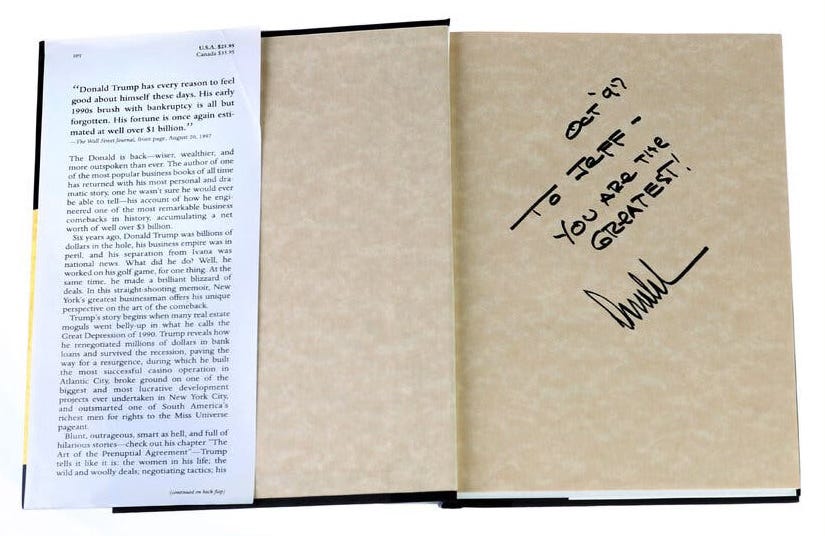
Trump and Epstein were photographed together repeatedly over many years. Trump once described Epstein to New York magazine as “a terrific guy” who liked women “on the younger side.” Epstein kept multiple contact numbers for Trump, as well as listings for Ivana and Ivanka Trump, in his personal directory. Newly released files include a photograph of Epstein holding Qaa novelty check bearing Trump’s signature. An email from Epstein to Maxwell in 2011 noted that “the dog that hasn’t barked is Trump” and claimed that Virginia Giuffre, one of Epstein’s most prominent accusers who died by suicide this year, had spent hours at Epstein’s house with him.
This is not proof of criminal conduct. It is proof of proximity. And proximity is precisely what the administration appears desperate to obscure.
That desperation was visible long before December 19. Trump spent months attempting to block the law’s passage, directing House Republicans not to sign the discharge petition that would force a vote. When even Marjorie Taylor Greene broke ranks in support of transparency, Trump erupted. He branded her “Marjorie Traitor Greene,” withdrew his endorsement, and publicly attacked her. Greene has since announced her resignation from Congress, citing death threats she attributes to Trump’s rhetoric. His response was chilling in its indifference: “I don’t think anybody cares about her.”
The irony here is almost too on-the-nose.
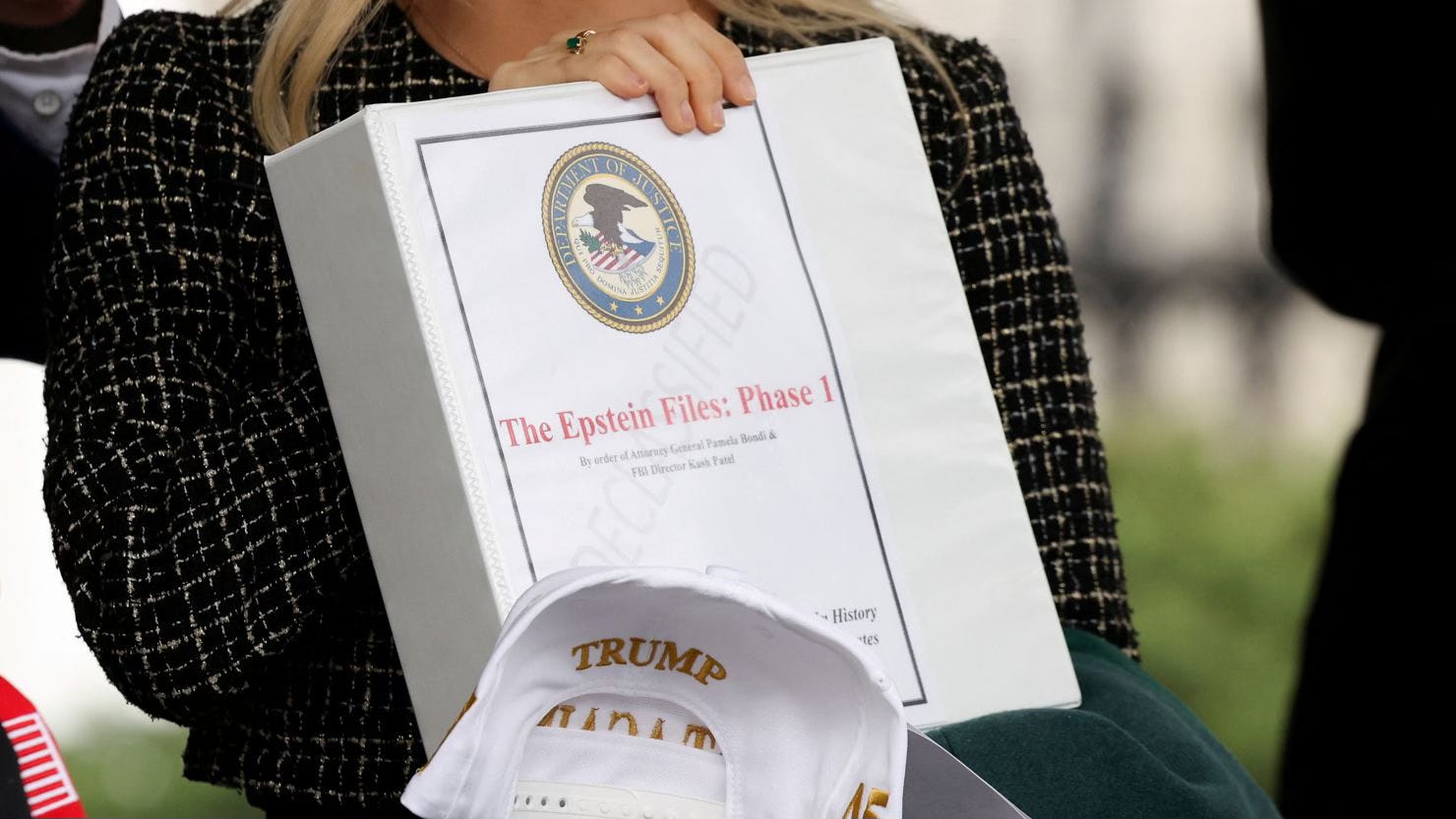
For years, Trump and his allies nurtured the QAnon movement, a conspiracy theory built on the claim that a secret cabal of elite pedophiles controlled the government, and that Trump alone was destined to expose them. Slogans like Save the Children proliferated. Figures such as Pam Bondi, Kash Patel, and Dan Bongino promised repeatedly that the Epstein files would reveal everything. Bondi even distributed binders labeled Epstein Files: Phase One to social media influencers.
The implication was clear: the files would implicate Democrats and vindicate Trump.
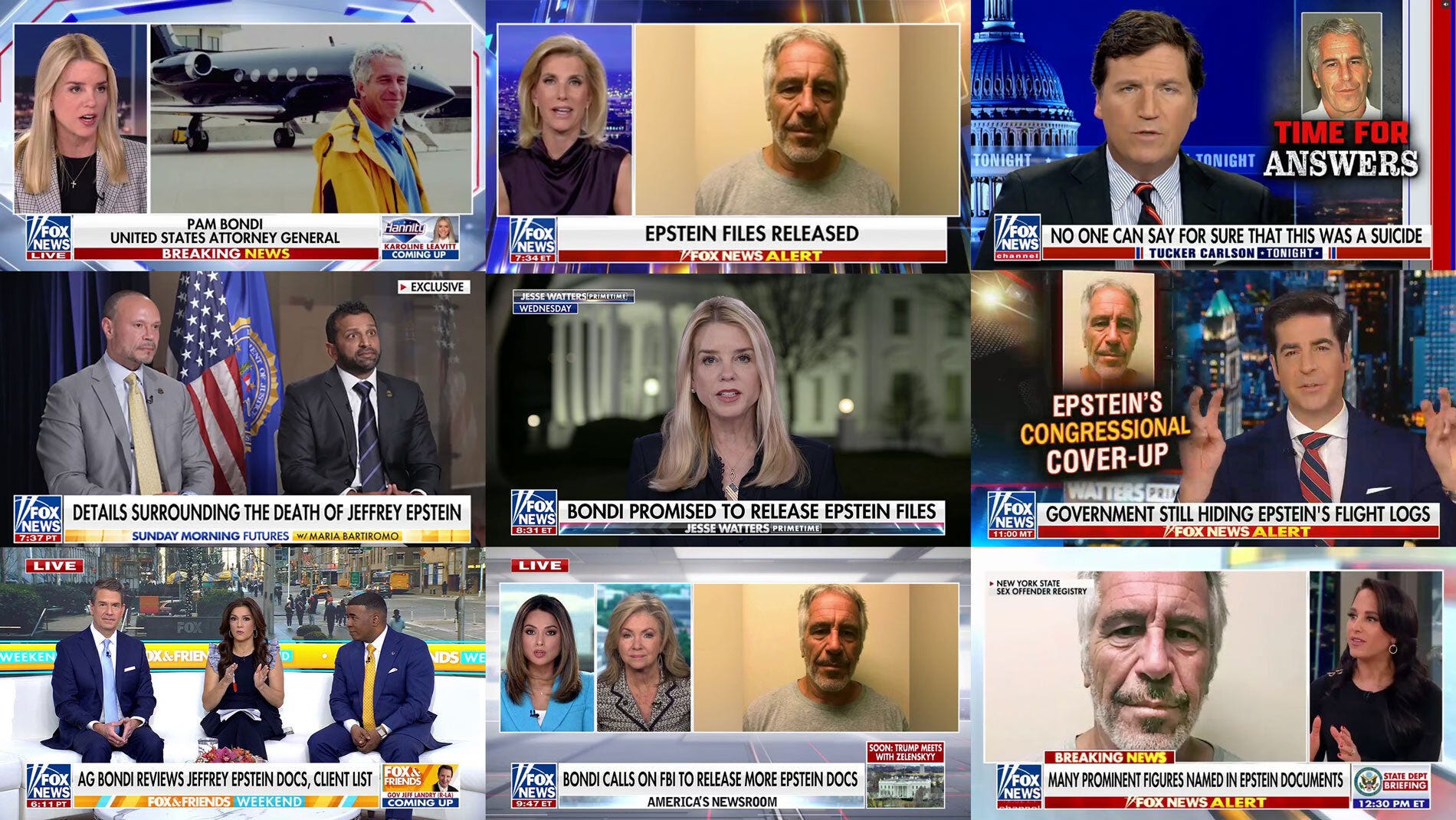
Instead, they have revealed Trump’s decades-long association with the most notorious sex trafficker of the modern era and a frantic institutional effort to bury that fact beneath black ink. The man cast as the scourge of elite predators turns out to have been at the parties. The savior was seated at the table.
One might expect this contradiction to provoke reckoning among Trump’s most ardent supporters. It has not. The same mental architecture that absorbed the failure of every QAnon prophecy — the storm that never came, the arrests that never happened — now absorbs this too. The delay is strategic. The deep state is sabotaging him. The truth will come later.
For those still capable of basic pattern recognition, the picture is clearer. The president of the United States is presiding over a Justice Department that is concealing information about his relationship with a convicted sex trafficker. A transparency law is being openly defied. Victims are being ignored. And the party that claims to defend children has closed ranks to protect a man whose efforts to prevent disclosure bordered on the frantic.
Accountability, it seems, remains reserved for the powerless.
Epstein escaped serious prosecution for years because he was rich and connected. His victims were dismissed because they were young and vulnerable. And now, even in death, his network of powerful associates continues to enjoy institutional protection. Each blacked-out page represents a decision. Someone looked at the evidence and chose concealment over disclosure.
When history records this episode, the black ink will speak louder than any press release. It will say that transparency was promised, and theater was delivered; that the law was invoked and ignored; that the truth was deemed too dangerous to reveal — not because it would harm victims, but because it might embarrass men who still matter.
The American public deserves better. The survivors deserve infinitely better. Instead, we’ve been handed thousands of pages where the truth has been replaced by its absence, a monument to cowardice masquerading as compliance.
The black ink has spoken. And it has told us exactly who, and what, it was meant to protect.
Did anyone really EVER believe the truth would be revealed? I was 100% certain that, despite the new “law,” no new info, especially regarding Trump, would come to light. He simply has too much power and is too desperate to contain the damage. He’ll literally do anything to contain it. The only way the truth comes out is if some undercover journalist somehow finally breaks the story with the right sources (probably after Trump is long gone). I’m not holding my breath….
Trump loves to say he’s “the most transparent president ever.” Meanwhile, Congress voted 427–1 to force the Epstein files open — and Trump’s DOJ/FBI are still sitting on 5.2 million pages. If there’s “nothing to hide,” why are we still in the dark?
This isn’t just about flight logs. It’s about: 🧬 DNA samples 🧬 Possible genetic experiments 🧬 Elite blackmail designed to shape who controls our future.
Every fact documented. Every source cited. 🔗 Read the breakdown they really don’t want in daylight:
https://geopoliticsinplainsight.substack.com/p/the-epstein-files-arent-about-sextheyre?r=72pxma